
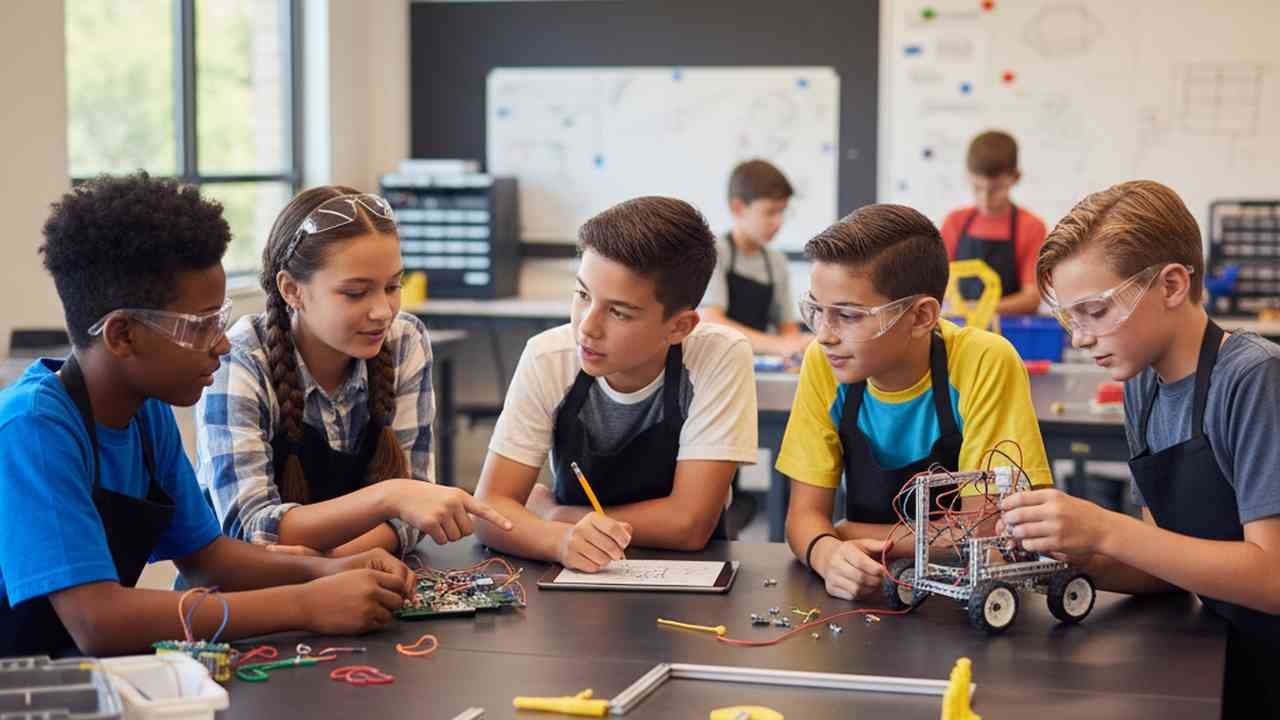
The Power of Hands-On Learning in STEM Education
Imagine walking into a classroom where the walls come alive with the buzz of students discussing, building, and problem-solving together. This is the magic of hands-on STEM (Science, Technology, Engineering, and Mathematics) projects that bring learning to life. It’s not just about textbooks and lectures; it’s about engaging with real-world problems and finding solutions through collaboration and communication. In today’s fast-paced educational landscape, where the future is driven by technology and innovation, the prospect education system has rapidly shifted its focus toward projects that challenge students to think critically, communicate effectively, and work as a team. These skills are crucial for success in the modern world, where collaboration is key to overcoming complex challenges.
Hands-on STEM projects are transforming how students learn, allowing them to gain a deeper understanding of abstract concepts by applying them to tangible tasks. When students work together to design a model bridge, build a robotic arm, or code an app, they develop practical problem-solving skills and learn to navigate the complexities of working as a team. The beauty of these projects lies in their ability to combine creativity with technical expertise, ensuring that students not only learn the theory but also gain the hands-on experience that will set them apart in the job market. The urgency of equipping the next generation with these vital skills cannot be overstated, and the prospect education system has already begun adapting to meet these needs.
Why Collaboration is Essential for Student Success
Collaboration isn’t just a buzzword in education – it’s a necessity. Students today are expected to work in teams, whether they are in the classroom, in future workplaces, or even in their personal projects. As technology advances, so does the complexity of the problems that students will need to solve. In a traditional classroom setting, students often work individually, each working on separate tasks with minimal interaction. However, hands-on STEM projects demand that students collaborate, share ideas, challenge one another’s thinking, and collectively create solutions. This is where the magic happens – when students realize that their combined efforts lead to better outcomes than any individual’s work could.
The importance of collaboration is becoming increasingly evident in today’s prospect education systems. Employers consistently cite teamwork and communication as some of the most crucial skills for success in the workplace. As the global workforce becomes more interconnected, the ability to collaborate with people from diverse backgrounds and with different skills is invaluable. STEM projects provide the perfect opportunity to cultivate these skills, offering students the chance to learn how to work effectively as part of a team. Whether it’s through brainstorming sessions, dividing tasks based on strengths, or troubleshooting problems together, the collaborative nature of these projects helps students understand that success doesn’t come from working alone – it comes from working together.
Communication Skills: A Key to Effective Collaboration
In any collaborative project, effective communication is essential. Imagine a team working on a complex robotics project, each student focusing on different components of the robot. Without clear communication, the various parts may not fit together as planned, or the team may struggle to identify and solve problems. Through hands-on STEM projects, students learn how to communicate their ideas clearly and listen to the perspectives of others. This exchange of ideas fosters a deeper understanding of the subject matter while improving interpersonal skills.
Effective communication is more than just speaking clearly; it’s about being able to convey complex technical concepts to people who may not have the same level of expertise. In a STEM classroom, students are often tasked with explaining their ideas to peers with different skills and backgrounds. This helps them develop the ability to simplify their thought processes and present them in ways that others can understand. The prospect education system recognizes that students who are proficient in communication will excel not only in academics but also in their future careers, where they will need to articulate ideas to colleagues, clients, and stakeholders.
Hands-On STEM Projects That Foster Teamwork
Whether it’s building a solar-powered car, creating a video game, or designing a sustainable city, the possibilities for hands-on STEM projects are endless. These projects often require a multidisciplinary approach, meaning that students must collaborate with their peers to combine knowledge from different areas of STEM. For example, when designing a wind turbine, students must apply principles of physics, engineering, and mathematics to create a functional prototype. Each student may take on a specific role, such as designing the blades, calculating wind speed, or testing the final product.
One of the key benefits of hands-on STEM projects is that they provide a sense of accomplishment that comes from seeing an idea come to life. As students work together to tackle challenges, they begin to realize that each member’s contributions are essential to the overall success of the project. The shared goal of completing the project fosters a sense of camaraderie and unity, teaching students that effective teamwork is not about individual recognition, but about mutual respect and collaboration. This experience is invaluable in preparing students for future careers, where collaboration and teamwork are often the foundation for success.
The Role of Problem-Solving in STEM Education
At the heart of every hands-on STEM project lies a problem to be solved. Whether it’s designing a more efficient engine, developing a new app, or finding a solution to a local environmental issue, students are constantly faced with challenges that require creative thinking and innovation. Problem-solving is a skill that is cultivated through hands-on experience, and it’s one of the most important skills students can develop in today’s rapidly changing world.
As students work through problems together, they begin to understand that there are often multiple solutions to any given issue. This fosters a growth mindset, where students are encouraged to try new approaches, learn from failure, and continuously improve their ideas. The process of working through complex problems in a group setting also teaches students how to evaluate and critique ideas constructively, a skill that is essential in both academic and professional environments. The prospect education system is increasingly focused on developing these problem-solving skills, recognizing that they are crucial for success in a world where innovation and creativity are highly valued.
Building Critical Thinking Through Hands-On STEM Projects
Critical thinking is one of the most valuable skills students can gain from hands-on STEM projects. As students work together to solve problems, they must evaluate different solutions, consider various perspectives, and make decisions based on logic and evidence. This process encourages students to think critically, challenge assumptions, and make informed choices.
For instance, when tasked with designing a structure that can withstand an earthquake, students must apply principles of engineering, physics, and material science. They must consider the properties of different materials, the design of the structure, and the forces at play during an earthquake. This requires a deep understanding of the concepts involved and the ability to think critically about how to apply them in real-world scenarios. As students collaborate, they learn how to analyze situations from different angles, weigh pros and cons, and come up with the best possible solutions.
The Benefits of Hands-On STEM Projects Beyond the Classroom
The benefits of hands-on STEM projects extend far beyond the classroom. These projects help students develop skills that will be valuable throughout their lives and careers. The ability to collaborate, communicate, and solve problems is essential not only in academic settings but also in the workforce and in personal endeavors. As the world becomes more interconnected and technology-driven, the skills gained from hands-on STEM projects are becoming more sought after by employers.
Furthermore, hands-on STEM projects often spark a lifelong interest in science and technology. When students see the real-world applications of what they’re learning, they are more likely to pursue careers in STEM fields. The prospect education system recognizes this and is increasingly focusing on providing students with opportunities to engage in hands-on projects that will inspire them to continue exploring STEM subjects throughout their lives.
How Hands-On STEM Projects Can Help Close the Achievement Gap
One of the greatest challenges in education today is the achievement gap – the disparity in academic performance between students from different socioeconomic backgrounds. Hands-on STEM projects have the potential to help close this gap by providing all students with equal opportunities to engage in meaningful, real-world learning experiences. When students are actively involved in projects that require collaboration, critical thinking, and problem-solving, they are more likely to stay engaged and motivated to succeed.
Moreover, hands-on STEM projects often provide a level playing field for students with varying learning styles. Some students may struggle with traditional teaching methods, but they may excel in a hands-on learning environment where they can apply their skills in practical ways. By fostering a more inclusive and engaging learning environment, hands-on STEM projects can help all students reach their full potential.
