
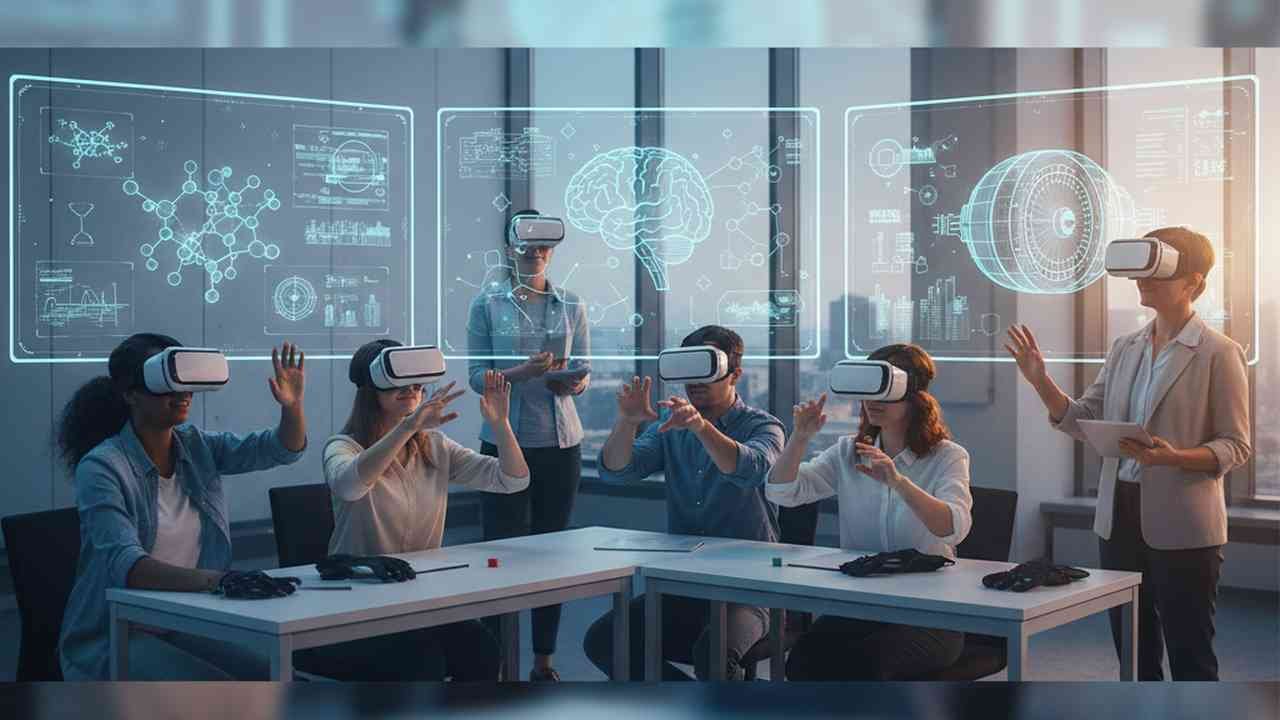
The Rapid Evolution of Virtual Learning and Why You Can’t Afford to Wait
There is a powerful wave sweeping through the world of education, reshaping how students and professionals engage with complex knowledge. It’s not just a trend; it’s a transformation that’s happening right now – and those who hesitate risk being left behind. Virtual Reality (VR) simulations have exploded in adoption across schools, universities, and corporate training programs. With technology accelerating at breakneck speed, the way we teach and absorb intricate concepts has shifted from static textbooks to immersive, 360-degree virtual environments. The stakes couldn’t be higher. Institutions that fail to embrace these tools will soon find their educational models outdated, their learners disengaged, and their reputations slipping away. This isn’t science fiction – it’s the new reality of educational innovation. Imagine standing inside a virtual molecule, watching atomic bonds form and break before your eyes, or walking through a simulated cardiovascular system as the human heart beats thunderously around you. These experiences bring impossible-to-see processes to life with a level of immediacy that traditional methods simply can’t match. The urgency to integrate VR into teaching strategies has never been greater. The demand for educational products tx that leverage VR technology is skyrocketing, driven by the expectation that learning should be both interactive and unforgettable. If your institution isn’t already exploring these immersive teaching tools, you are already falling behind in a rapidly evolving digital education landscape.
Immersive Engagement: Turning Passive Learning into Active Experience
Traditional learning relies heavily on reading, memorizing, and abstract reasoning. VR simulations break through those barriers, replacing passivity with action. Learners don’t just observe – they participate. A biology student can virtually perform dissections with precision, seeing every detail of anatomy in lifelike realism. Engineering students can build and test prototypes without the cost or danger of real materials. The texture of machinery, the hum of simulated environments, and the vivid, responsive interfaces create an emotional connection to learning that textbooks can’t offer. This sensory engagement boosts retention and motivation dramatically. The sense of being “inside” the learning experience creates neural pathways that help learners grasp difficult ideas faster. Institutions using educational products tx that incorporate VR report higher test scores, deeper comprehension, and increased enthusiasm among learners. The competitive pressure is real – students and corporate trainees alike are demanding these dynamic experiences because they understand the career advantages that come with practical, immersive understanding. Every day you delay integrating VR simulations into your educational model, you risk losing your learners to platforms that deliver more interactive, memorable, and effective instruction. The time to transform passive classrooms into immersive arenas of discovery is now.
Bringing Abstract Theories to Life Through Real-World Simulation
One of the greatest barriers in education has always been translating theory into practice. Concepts in physics, chemistry, or economics often remain abstract until they can be experienced in real-world scenarios. VR simulations collapse that gap instantly. Imagine students walking through a digital stock market floor to understand the mechanics of trading, or exploring gravitational forces firsthand as they float through a simulated solar system. These experiences give learners an immediate sense of cause and effect, making theories tangible. The excitement is contagious – students lean in, participate, and explore rather than passively take notes. Teachers become facilitators of discovery instead of lecturers repeating facts. Leading universities using educational products tx integrated with VR have reported dramatic increases in retention rates and student satisfaction. What was once theory-heavy and intimidating suddenly becomes intuitive and thrilling. The psychological impact of these hands-on, immersive experiences is profound – learners retain not just the information, but the emotional and sensory memory of the lesson itself. It’s no wonder employers increasingly prefer graduates trained with VR technologies; they arrive job-ready, confident, and capable of handling complex tasks from day one. The difference between traditional learning and VR-enhanced learning is the difference between reading about a thunderstorm and standing in the middle of one – completely enveloped, alert, and transformed.
Real-World Applications Across Industries and Professions
VR simulations have transcended classroom walls, finding critical roles in industries ranging from healthcare to aviation, engineering, architecture, and beyond. Surgeons train on virtual patients, mastering delicate procedures without risk. Pilots practice emergency responses in hyper-realistic cockpits. Architects walk clients through yet-unbuilt skyscrapers, fine-tuning every detail before construction begins. The results are astounding – reduced errors, lower costs, and accelerated learning cycles. Corporations seeking efficiency are now investing heavily in educational products tx to provide immersive employee training that eliminates expensive mistakes and improves safety compliance. In manufacturing, for example, technicians can learn machine operation within a controlled digital environment where errors carry no physical consequences. The power of virtual experience lies in its flexibility – it adapts instantly, providing feedback, simulating failures, and rewarding progress. The competitive advantage for organizations adopting VR training early is undeniable. They produce faster, smarter, and more adaptable professionals. As industries evolve, the demand for workers who’ve trained in these immersive systems will surge. Missing this shift means missing the future of workforce education. The clock is ticking, and those not harnessing VR today will soon struggle to compete in tomorrow’s innovation-driven economy.
Why Educational Institutions Are Racing to Integrate VR Technologies
Across the globe, forward-thinking educators are realizing that the traditional classroom model cannot keep pace with modern learners. Students raised on interactive media expect dynamic, participatory experiences. To meet this demand, schools, universities, and training centers are rapidly adopting VR-enhanced curricula. Institutions utilizing educational products tx built around VR are witnessing enrollment booms and heightened engagement. Learners talk about their experiences online, sharing clips of virtual experiments or digital explorations, creating a viral enthusiasm that draws new students. This network effect has made VR not just an educational innovation but a marketing powerhouse. Accreditation bodies and educational councils are also beginning to recognize VR as a legitimate instructional medium, further legitimizing its role in formal education. Delaying adoption risks falling out of alignment with global standards. Early adopters have already proven that VR classrooms lead to better academic outcomes and increased institutional prestige. Those that act now will define the future of learning; those that hesitate will soon find themselves playing catch-up, struggling to attract digitally savvy learners who expect immersion, not passivity. The race is on, and the finish line rewards only those who embrace the transformation.
Technical Foundations and Security of VR Educational Systems
One critical question many educators ask before investing in VR-based learning is about reliability, security, and scalability. Modern educational products tx have advanced far beyond experimental prototypes. Today’s systems use secure cloud architectures, encrypted data handling, and licensed content verified by educational boards. Institutions can deploy VR platforms across multiple campuses or integrate them into online portals without sacrificing safety or performance. These systems are built to scale effortlessly, ensuring consistent experiences across different devices and bandwidths. The responsiveness of modern customer service teams ensures that educators receive real-time assistance during setup and instruction. Licensing agreements guarantee access to constantly updated simulation libraries, ensuring courses stay aligned with current industry standards. Verified payouts and transparent pricing models protect educational institutions from hidden fees or technical risks. What once seemed like a futuristic luxury has become a dependable infrastructure for serious learning. The combination of advanced graphics processing, haptic feedback, and AI-driven personalization means every learner experiences content tailored to their pace and skill level. The result is a secure, responsive, and deeply personalized learning environment where data is protected and experiences are optimized. In a world increasingly concerned about cybersecurity and credibility, this transparency builds lasting trust and confidence among administrators, teachers, and learners alike.
Empirical Evidence and Proven Results Driving Adoption
Beyond the hype, real data tells a compelling story. Studies from trusted academic journals and independent research institutions reveal that VR-based learning consistently produces measurable gains. Learners retain up to 75% more information when taught through immersive simulation compared to traditional lectures. Reaction times improve, comprehension deepens, and application of complex concepts becomes more intuitive. In trials across universities using educational products tx, students demonstrated not just better test performance but improved confidence in practical application. In corporate environments, training completion times dropped by up to 40%, while error rates during post-training evaluations plummeted. These statistics are not theoretical – they represent the lived experiences of thousands of learners and educators worldwide. Real-world case studies confirm that immersive teaching delivers higher ROI, improved engagement, and stronger brand loyalty for educational institutions. The consistency of these findings is impossible to ignore. For administrators evaluating next-generation teaching tools, the empirical evidence in favor of VR is overwhelming. The question is no longer “does it work?” but rather “how quickly can we integrate it before competitors gain the upper hand?” Those who act now stand to capture both the academic and financial benefits that come with leading the digital education revolution.
Creating Urgency: Why Delaying VR Integration Costs More Than You Think
The cost of waiting is far higher than the cost of action. Every semester without immersive learning options erodes your institution’s competitive edge. Students gravitate toward programs that promise real-world readiness, interactive engagement, and innovative teaching methods. Parents and corporate sponsors invest in schools that demonstrate forward momentum and technological fluency. Failing to integrate VR simulations risks not only losing prospective students but also diminishing brand reputation and revenue streams. Meanwhile, those investing in educational products tx now are already leveraging government grants, industry partnerships, and early adopter discounts that may not exist in another year. The technology is improving rapidly, but the first-mover advantage is narrowing. Institutions that establish VR programs today will have alumni networks, partnerships, and market recognition tomorrow. Waiting means not just falling behind technologically but becoming irrelevant in the minds of digital-native learners. The message is clear: the time to act is now. Every moment of hesitation is an opportunity lost to your competitors who are already building the classrooms of the future.
The Call to Action: Seize the Future of Education Now
The landscape of learning is transforming before our eyes, and those who lead this movement will define education for decades to come. By adopting educational products tx designed for immersive VR learning, your institution positions itself as a pioneer of innovation, relevance, and excellence. Students will remember where they first experienced the power of learning that felt like living. Educators will find renewed passion in guiding exploration rather than dictating memorization. Administrators will see stronger enrollment, glowing reviews, and sustained growth. The time to invest in these technologies is not next year or next quarter – it is today. Don’t let your competitors take the lead while you deliberate. Visit https://www.txedtech.com and discover how their VR-driven educational products can revolutionize your teaching environment. Their proven results, verified licensing, and trusted customer support make them the go-to choice for institutions ready to step boldly into the future of learning. Act now, because in the race to define the next era of education, hesitation is the only true failure. Make the leap, embrace immersion, and shape the future before it shapes you.
As you explore new educational technologies, consider how immersive experiences can also enhance personal adventures, such as discovering the best places to visit in Outer Banks, North Carolina, where stunning beaches and rich history await your exploration.
